
Mandat ad hoc et conciliation
Agir tôt pour sauver son entreprise
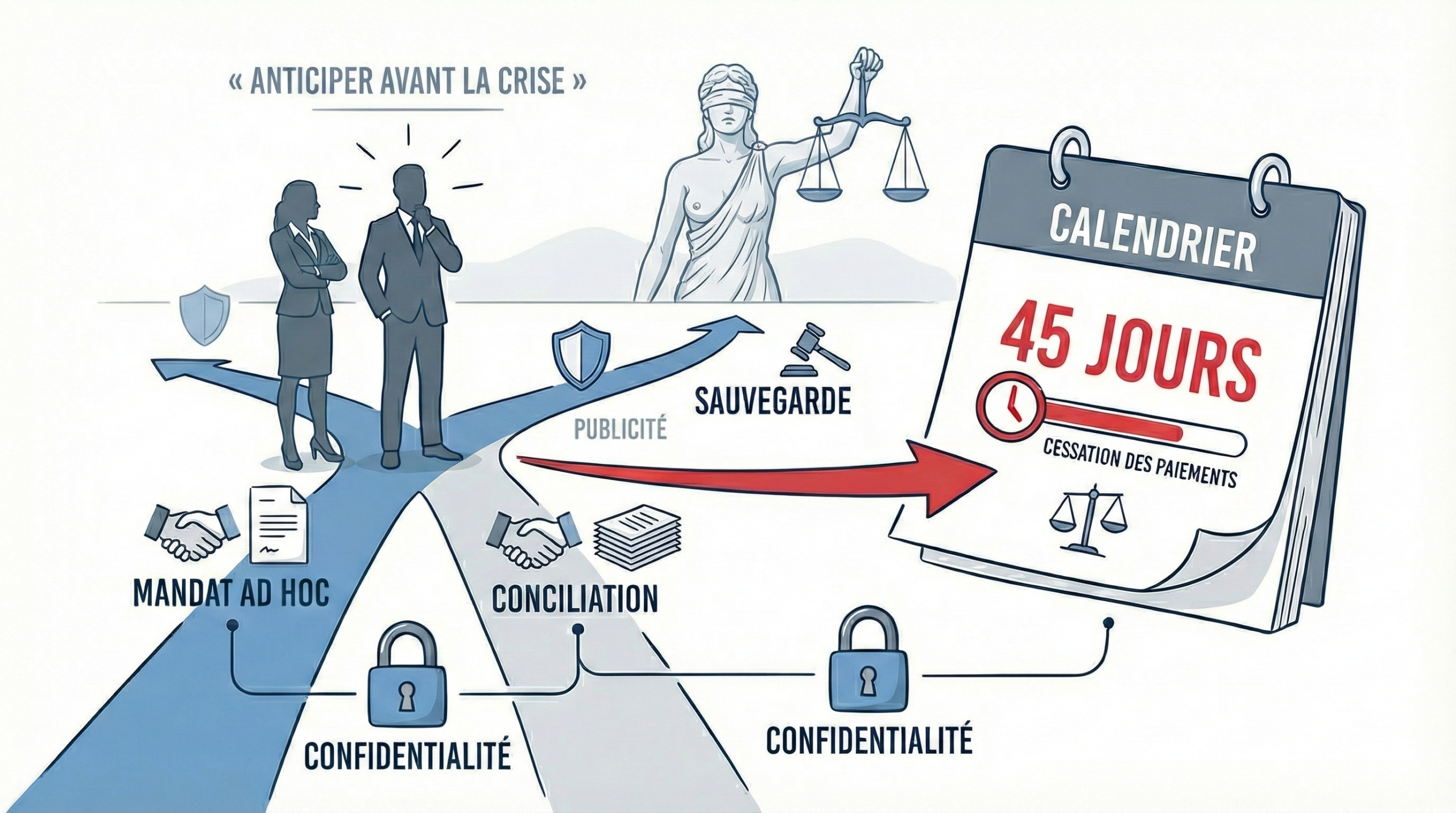
Mandat ad hoc et conciliation : agir tôt pour sauver son entreprise
Lorsqu’une entreprise commence à rencontrer des difficultés financières, le véritable danger n’est pas toujours la situation économique elle-même, mais le retard de réaction. Très souvent, les dirigeants continuent d’avancer « à l’instinct », sans disposer d’une vision claire de leur trésorerie, de leurs engagements ou de leurs marges de manœuvre.
Dans ce contexte, les procédures amiables comme le mandat ad hoc et la conciliation constituent des outils puissants de prévention des difficultés d’entreprise. Pourtant, ils restent largement sous-utilisés, faute d’information et par crainte injustifiée du tribunal…
Pourquoi les dirigeants agissent trop tard face aux difficultés financières
Dans la majorité des cas, les dirigeants ne manquent ni de lucidité ni de bonne volonté. Mais plusieurs freins reviennent systématiquement :
• une méconnaissance de la situation financière réelle de l’entreprise,
• l’absence de ressources financières ou juridiques internes,
• une charge opérationnelle qui laisse peu de place à l’analyse,
• la peur d’« officialiser » les difficultés.
Résultat : lorsque les problèmes deviennent visibles, il est parfois déjà trop tard. L’entreprise entre alors dans une spirale qui mène directement à des procédures collectives lourdes, voire à la liquidation judiciaire.
Mandat ad hoc et conciliation : des procédures amiables encore méconnues
Le mandat ad hoc et la conciliation sont des procédures prévues par le Code de commerce. Elles peuvent intervenir avant que la situation ne devienne critique. Elles font partie des dispositifs de prévention des difficultés d’entreprise.
Leur point commun : elles reposent sur la négociation amiable, la confidentialité et le maintien du dirigeant aux commandes.
Le mandat ad hoc : une solution souple et confidentielle
Le mandat ad hoc s’adresse aux entreprises qui ne sont pas en cessation de paiements. Il permet au dirigeant de solliciter le président du tribunal de commerce afin de désigner un mandataire ad hoc, tiers indépendant.
Cette procédure présente plusieurs avantages :
• elle est totalement confidentielle,
• elle s’adapte au rythme et aux besoins de l’entreprise,
• elle facilite le dialogue avec les créanciers,
• elle permet de rechercher des solutions sur mesure (rééchelonnement, négociation de dettes, nouveaux financements).
La conciliation : sécuriser un accord avec ses créanciers
La conciliation peut être engagée tant que l’entreprise n’est pas en cessation de paiements ou depuis moins de 45 jours.
Elle permet d’aller plus loin :
• formalisation d’un accord global avec les créanciers,
• possibilité d’homologation par le tribunal,
• sécurisation juridique des engagements,
• accès au privilège de « new money » pour les financeurs.
C’est un levier particulièrement efficace pour éviter une liquidation judiciaire lorsque les difficultés sont encore maîtrisables.
Pourquoi ces procédures fonctionnent quand elles sont engagées tôt
50 à 70 % des procédures amiables aboutissent à un accord lorsqu’elles sont déclenchées suffisamment tôt. Pourtant, elles ne représentent qu’une faible part des procédures ouvertes chaque année.
Agir en amont permet :
• de conserver la confiance des partenaires financiers,
• de préserver la réputation de l’entreprise,
• d’éviter les décisions prises dans l’urgence,
• de sécuriser l’activité et l’emploi.
Le rôle clé de l’accompagnement du dirigeant
Mandat ad hoc et conciliation ne s’improvisent pas. Leur efficacité repose en grande partie sur la qualité de l’accompagnement du dirigeant.
Être entouré de professionnels indépendants, capables de :
• analyser la situation financière,
• structurer un discours crédible,
• préparer les négociations,
• anticiper les impacts à court et moyen terme,
Tout cela constitue un facteur déterminant de succès, en particulier pour les PME.
Mandat ad hoc et conciliation : des outils de pilotage, pas de dernier recours
Contrairement aux idées reçues, ces procédures ne sont pas synonymes d’échec. Elles sont au contraire des outils de pilotage et de gestion. Ces outils sont pensés pour aider les dirigeants à traverser une période délicate tout en préservant l’avenir de leur entreprise.
Agir tôt, c’est garder la main sur les décisions.
Quand faut-il envisager un mandat ad hoc ou une conciliation ?
Certains signaux doivent alerter :
• tensions de trésorerie récurrentes,
• difficultés à honorer les échéances,
• dépendance accrue à un financeur,
• absence de visibilité à moyen terme.
👉 Le bon réflexe : ne pas attendre.
Plus l’intervention est précoce, plus les solutions sont nombreuses.